
Running a car rental business in Senegal means managing vehicles you cannot see. Cars are scattered across the city, renters come and go, and without visibility, problems compound: late returns go unnoticed, unauthorized trips happen undetected, and stolen vehicles disappear for days before anyone acts.
GPS tracking solves these problems by giving rental operators full visibility and control over every vehicle in the fleet.
The Core Challenges of Car Rental
Car rental fleet management has specific constraints that general fleet tracking does not address:
- Vehicles change hands constantly: unlike a company fleet with assigned drivers, rental cars have a different person behind the wheel every few days
- Geographic boundaries matter: renters may be restricted to certain regions, and crossing borders creates insurance and legal complications
- Turnaround time is revenue: every hour a car sits idle between rentals is lost income
- Theft risk is elevated: handing keys to strangers means trusting people you have never met
Without GPS, a rental operator loses an average of 15 to 25% of revenue to preventable incidents.
| Risk | Financial consequence | GPS solution |
|---|---|---|
| Vehicle theft | Total loss (3-15M FCFA) | Live tracking + engine cut |
| Zone violation | Accelerated wear, accident risk | Geofencing with alerts |
| Non-return | Lost rental revenue | Remote engine cut |
| Excessive mileage | Premature vehicle wear | Trip history |
| Dangerous driving | Costly repairs | Driving behavior analysis |
Live Fleet Visibility
Live tracking shows every vehicle on a single map with position updates every 10 seconds. At a glance, a rental manager sees which cars are on the road, which are parked at branch locations, and which should have been returned but have not.

This visibility transforms daily operations:
- Faster dispatch: when a customer needs a car, the manager sees which vehicles are closest and available
- Return monitoring: when a car is due back, you can verify whether it is heading toward the branch or still driving in the opposite direction
- Multi-branch coordination: operators with multiple pickup locations can balance inventory across branches based on where vehicles actually are
Geofencing: Enforce Rental Boundaries
Most car rental contracts restrict vehicles to specific regions. A car rented in Dakar should not end up in Bamako. Geofencing enforces these boundaries automatically.
The manager draws virtual boundaries around authorized areas. When a vehicle crosses a boundary, an instant alert is triggered.
Common geofencing setups for rental operators:
- City or region boundary: restrict vehicles to the greater Dakar area or to Senegal
- Long-term rental zone: for national rentals covering the whole country
- Airport perimeter: verify that airport rental returns actually reach the designated lot
- Branch zones: monitor which branch location a vehicle is nearest to for inventory balancing
"I have clients who rent to go to Gambia or Guinea without telling me. Geofencing alerts me immediately. I can intervene before the vehicle leaves the country." · Rental operator, Saint-Louis
Remote Engine Cut: The Rental Operator's Most Critical Tool
The remote kill switch changes the economics of theft. Without GPS, a stolen rental car may never be recovered. With live tracking and engine cut, recovery happens within hours.
Concrete use cases:
- Theft: immediate cut, location data transmitted directly to law enforcement
- Non-return: client fails to return the vehicle on time, you immobilize it remotely
- Payment default: the vehicle is locked until the client settles the account
- Unauthorized use: cargo transport, zone violations, contract breaches
- Economics: for a fleet of 20+ vehicles, a single prevented theft can pay for the entire GPS system for a year
Curfew Monitoring
Some rental contracts prohibit driving during certain hours, typically late at night. Curfew monitoring detects vehicle movement outside allowed time windows and sends an alert.
Particularly useful for:
- Corporate rentals: companies that rent vehicles for employees during business hours only
- Insurance compliance: some policies require vehicles to be stationary overnight
- Fleet protection: movement between 1 AM and 5 AM on a rental vehicle is unusual and worth investigating immediately
Trip History: Resolve Disputes with Objective Data
Rental disputes happen. A customer claims they returned the car on time. A damage report is contested. A renter says they never drove to a certain location.
Trip history provides an objective record: every route, every stop, exact timestamps. When a dispute arises, the data settles it. This protects both the rental company and honest customers.
"A client claimed to have driven only 200 km. GPS history showed 650 km. The additional charge was accepted without discussion, the evidence was there." · Rental operator, Thies
Trip history also helps with:
- Mileage verification: compare actual kilometers driven against the rental agreement
- Damage investigation: if a vehicle returns with damage, the route history shows where the car went, helping narrow down when and where the damage occurred
- Usage patterns: identify which routes and regions are most popular with renters, informing pricing and branch location decisions
Driving Behavior and Vehicle Care
Rental vehicles endure harder use than company-owned fleets. Renters who speed, brake hard, and take sharp turns accelerate wear and increase accident risk.
Driving behavior analysis and speed monitoring serve two purposes:
- Damage attribution: when a vehicle returns with mechanical issues, the driving data shows whether the renter drove aggressively
- Maintenance scheduling: vehicles with consistently harsh driving data need more frequent servicing
Activity Reports for Fleet Performance
Activity reports compile fleet-wide data into weekly or monthly summaries:
- Total kilometers per vehicle
- Average idle time between rentals
- Number of geofence violations
- Speed violations per rental period
- Vehicle utilization rates
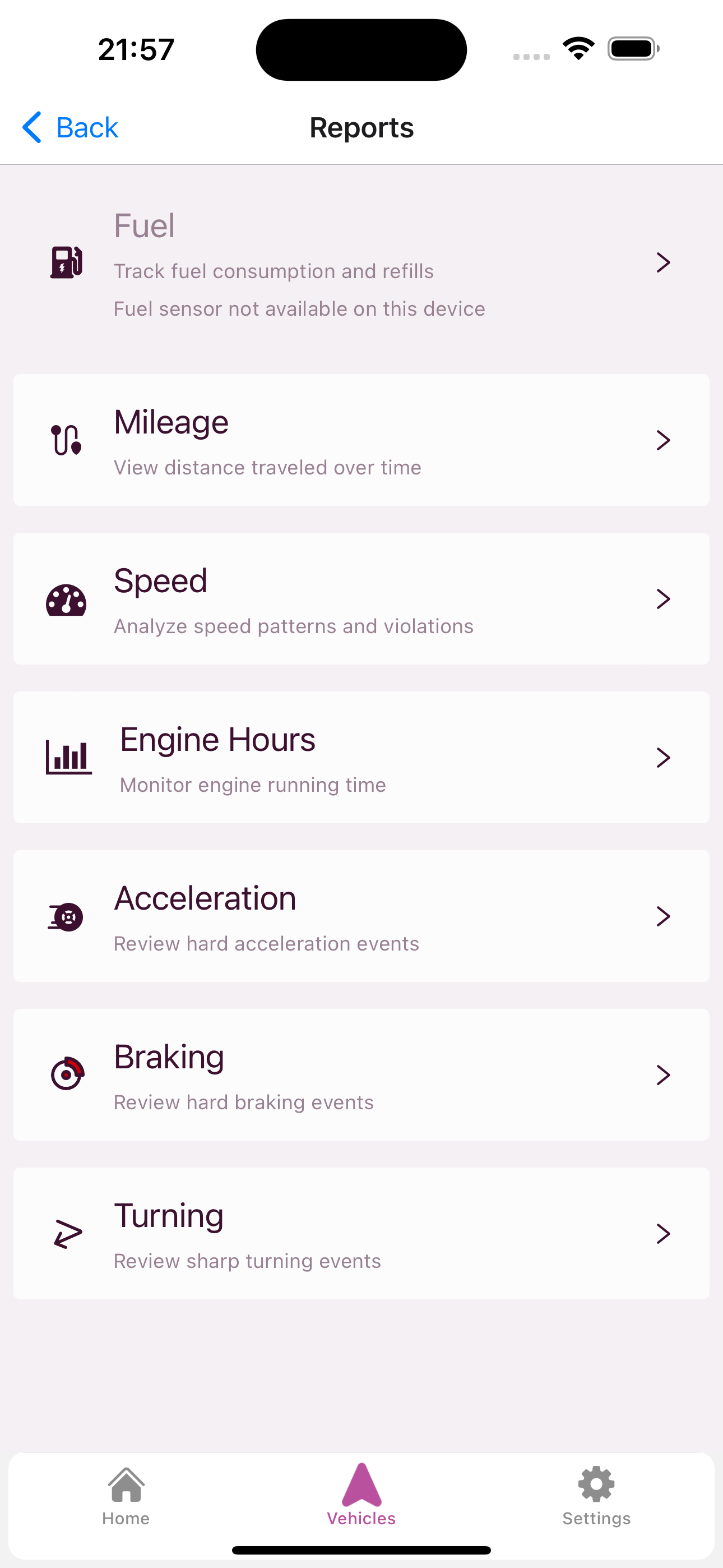
These reports help managers identify underperforming vehicles, optimize fleet size, and measure whether operational changes are working.
Customer Satisfaction: Build Trust Through Transparency
With live fleet visibility, you can:
- Predict exactly when a rental vehicle will be ready
- Locate and assist a customer who encounters trouble on the road
- Manage late returns proactively instead of reactively
When customers know you have invested in technology to keep them safe and informed, they feel valued. That feeling pays off in loyalty and word-of-mouth.
Return on Investment
For a fleet of 10 rental vehicles in Dakar:
| Item | Without GPS | With GPS | Impact |
|---|---|---|---|
| Thefts per year | 1-2 vehicles | 0 | Savings of 3-15M FCFA |
| Excessive mileage/month | +20% average | Controlled | Reduced wear |
| Non-returns/month | 2-3 incidents | 0 (engine cut) | Immediate recovery |
| Client disputes/month | 3-5 | 1 (GPS evidence) | Time savings |
| Avoidable repairs/year | 500,000 FCFA | 200,000 FCFA | -300,000 FCFA |
| Fuel savings/month | - | 150,000 FCFA | Covers subscription cost |
GPS cost (10 vehicles, Basic plan): 60,000 FCFA/month + 400,000 FCFA initial investment. A single prevented theft pays for years of subscription.
Typical Workflow: From Handover to Return
At vehicle handover
- Verify GPS mileage (not just the odometer, which can be tampered with)
- Set the authorized zone according to the rental contract
- Activate zone violation and curfew alerts
- Client signs the contract with GPS tracking disclosure
During the rental
- Monitor the vehicle live if needed
- Receive alerts for zone or speed violations
- In case of problems, cut the engine remotely
At return
- Review trip history: actual mileage, zones visited
- Compare GPS mileage with the client's declaration
- In case of discrepancy, GPS history serves as billing evidence
Real Scenarios
Late return: a customer is 90 minutes late returning a popular sedan, and another client is waiting. You check the dashboard, see the sedan is stuck in traffic a few kilometers away, and proactively contact the waiting customer to manage expectations.
Theft recovery: a luxury SUV goes missing overnight. You instantly see its location and movement history. Law enforcement recovers the vehicle quickly, minimizing losses. Your insurance premiums may stabilize over time, reflecting the lower risk.
Damage dispute: a vehicle returns with bodywork damage. The renter denies it. Speed and harsh driving data from the trip confirm aggressive driving, and the GPS route history shows the neighborhood where the damage likely occurred.
"Before GPS, I lost one vehicle per year on average. It has been two years since I got equipped, zero thefts. GPS pays for itself." · Rental operator, 15 vehicles, Dakar
Best Practices for Rental Operators
- Start small: if new to GPS tracking, begin with a subset of your fleet. Learn the ropes, customize settings, then roll out fleet-wide
- Train your staff: a brief session ensures everyone knows how to access reports, set geofences, and interpret the data
- Set clear goals: reduce fuel costs by 10%? Cut late returns by 15%? Establish targets so you can measure impact
- Communicate with customers: let customers know you use GPS tracking. Position it as a benefit that ensures their safety and timely service
- Review data regularly: check fleet performance weekly. Look for patterns, anomalies, or areas that need improvement
What Rental Operators Need in a GPS System
| Feature | Rental Application |
|---|---|
| Live tracking | Locate any vehicle instantly, monitor returns |
| Kill switch | Recover stolen or unreturned vehicles |
| Geofencing | Enforce regional rental boundaries |
| Curfew | Detect after-hours driving violations |
| Trip history | Resolve disputes with objective data |
| Speed alerts | Document aggressive driving |
| Driving behavior | Attribute damage to driving patterns |
| Activity reports | Measure fleet utilization and performance |
| Team access | Give branch managers visibility over their vehicles |
Recommended Plans for Rental Operators
| Plan | Price/vehicle | Recommendation |
|---|---|---|
| Basic | 6,000 FCFA/month | Small fleet (1-5 vehicles), anti-theft protection |
| Premium | 10,000 FCFA/month | Medium fleet (5-20 vehicles), full management |
| Platinum | 125,000 FCFA/month | Large fleet (20+), management software integration |
For most rental operators, the Basic plan is sufficient: it includes live tracking, engine cut, geofencing, and 15 days of trip history. The GPS device costs 25,000 FCFA with 15,000 FCFA professional installation.
Get Started
GPS tracking turns a car rental fleet from an exposed liability into a managed asset. Every vehicle is visible, every boundary is enforced, and every dispute has data behind it.